


Development & Community Fund
Do you have an idea to strengthen career development or the research community at MUI? The Community & Development Fund supports researcher-led initiatives such as working groups, lecture series, writing groups, or exchange formats with industry. Scientific staff can apply twice a year for funding of up to € 3,000 to develop research and career skills, strengthen internal and international connections, and actively contribute to a vibrant research culture at our university.
Application
The deadlines are April 15 & September 15. Find all information here.
Supported projects

Join the Team Channel to stay up to date: MitoLectures
Scope: This is a cross-departmental, researcher-led lecture series that brings together experts and researchers in mitochondrial biology and pathology from the fields of basic, translational and clinical research. The initiative aims to strengthen knowledge exchange and collaboration across the Medical University of Innsbruck, Leopold-Franzens-University, and the South Tyrol Institute for Biomedicine. The core of the MitME initiative is networking, bringing people to MEET together to discuss mitochondrial physiology and pathophysiology.
Format: The series will comprise five 60-minute hybrid seminars (on-site and livestreamed). It will feature a keynote lecture and presentations on available and/or innovative methodologies and emerging topics in mitochondrial research, including pitfalls. Topics will include mitochondrial dynamics, immunometabolism, mitochondrial genetics, bioenergetics, advanced imaging, omics and metabolism.
Target audience: Postdoctoral researchers, scientific staff, PhD students and clinicians, with a particular focus on fostering networking and expertise on mitochondrial biology.

Scope: Ethical and philosophical debate within the medical and biological sciences is often neglected or restricted to a limited context, primarily focusing on immediate clinical patient care. However, scientific research is increasingly shaping our everyday lives in profound and sometimes unpredictable ways. In short, there is a growing need to engage with philosophical questions that extend far beyond the laboratory bench. Fiction and cinema have long served as powerful catalysts for testing concepts and forming ideas; however, translating their underlying philosophical core remains ambiguous. We believe that researchers, students and the public all have valuable insights into current scientific developments. To address this gap, we propose a four part Philosophy Film Night series, an accessible and intuitive platform designed to spark deeper discussion surrounding the ethical and philosophical dilemmas embedded in modern research.
Format: Each session centres on a film with a strong connection to science and philosophy, selected by an invited speaker.
- Introduction (15 mins): A brief introductory lecture framing the central philosophical themes of the film, allowing you to watch with a focused perspective.
- Film Screening: The featured film is screened following the introduction.
- Guided Dialogue: After a short break, we gather for an inclusive, structured dialogue between the speaker and the audience.
- Networking & Informal Exchange: Each evening concludes with light refreshments (such as pizza and drinks), providing a relaxed space to continue the conversation.
- Duration: Approximately 3 to 4 hours per session, depending on the film and discussion flow.
Target Audience: Bachelor, Master and PhD-students. Postdoctoral researchers & Primary Investigators.

Scope: This pilot project is a pediatrics-specific, resident-led support and skills series that creates a safe, structured space for the transition from training to independent clinical practice. The initiative aims to close the onboarding gap for new pediatric residents, foster peer exchange, practical problem-solving, and career planning, and thereby reduce frustration and avoidable errors. It complements existing mentoring and buddy programs with needs-driven, practice-focused offerings. Following a successful pilot, expansion to additional cohorts (including other specialties) is envisioned.
Format: three to five 60-minute hybrid sessions (on-site and livestreamed) per semester. Each session includes:
- A short keynote or impulse talk (10–15 min) on core transition-to-practice themes in pediatrics
- A methods/how-to segment (15–20 min) with concrete tools and workflows from practice
- A moderated peer-to-peer forum (20–30 min) for case-based discussion, everyday challenges, and shared solutions under clear safe-space and confidentiality rules.
- Needs-driven design: A dedicated email address will collect topics, questions, and concerns in advance. A team of pediatric specialists will curate content based on submissions and moderate the sessions.
- Sessions will also highlight existing resources (mentoring, buddy, and onboarding programs) and conclude with actionable takeaways and signposts for further support.
Participants will be organized into small groups, each assigned to a dedicated mentor who is available for day-to-day questions and acute issues. Additionally, the program will include supplemental sessions led by external speakers on conflict management, difficult conversations, and advanced communication skills.
Target audience: pediatric resident physicians (pilot cohort), optional participation by interested mentors/senior residents to support networking and alignment with existing programs.
Pilot and scaling: Evaluation after each session (quick feedback) and at semester end (needs and impact assessment).
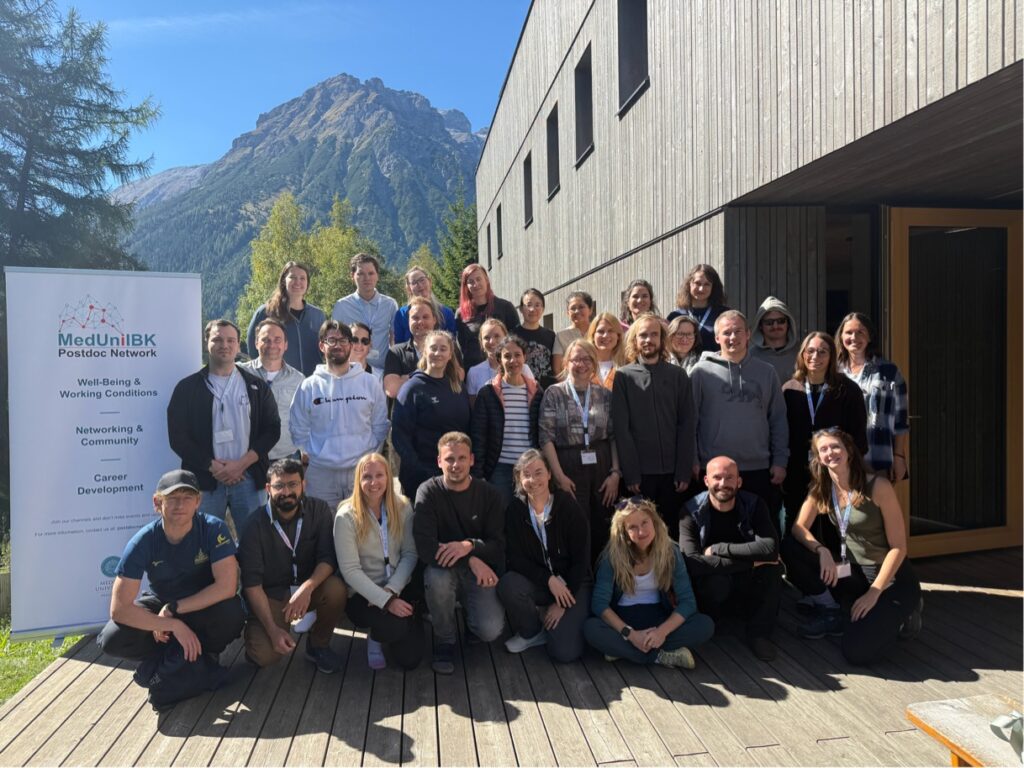
Scope: As part of Postdoc Appreciation Week 2026, the Med Uni Innsbruck Postdoc Network organized a funded two-day retreat in Obernberg. The event brought together postdoctoral researchers from different departments to exchange knowledge, share experiences, and strengthen their professional networks in an informal setting.
Format: The retreat combined lightning talks, skill sharing, interactive workshops, networking, and outdoor activities. Workshops focused on science communication and presentation skills, complemented by a collaborative treasure hunt and a hike to Obernberger See.
Target Audience: Postdocs from all fields and career stages

Historically and geographically, Innsbruck is strongly linked to hypoxia/altitude research. In the last decades, researchers have started to systematically explore the potential of altitude and associated hypoxia to promote health and potentially extend life- and health-span has been discovered. For example, it has been shown that living at moderate altitudes (1000 – 2500 m above sea level) reduces mortality from cardiovascular diseases and overall mortality in Alpine countries, such as Switzerland, Italy and Austria.
High altitude is characterized by a reduced barometric pressure resulting in lower oxygen availability and inspiratory hypoxia. Increasing evidence shows that such inspiratory hypoxia by itself (in laboratory instead of mountainous environments) can promote various aspects of healthy aging and of mental health as well.
Importantly, severe hypoxia may even accelerate aging, as shown in cell and animal models, and increase the risk for age-related diseases, which often are tightly linked to tissue hypoxia. In contrast, mild controlled hypoxia induces protective physiological responses and adaptation that reduce the risk of age-related cardiovascular and neuropsychiatric diseases.
Hypoxia interventions have recently been repeatedly shown to reduce depressive and anxiety symptoms, improve cognitive capacities and executive functions, and slow down cognitive decline, especially in older humans and those with mental illnesses.
Moreover, important clinical trials are currently ongoing evaluating the potential of therapeutic hypoxia in age-related neurodegenerative diseases, such as in Parkinson’s disease and in mental illnesses like depression. Several systematic reviews confirmed that intermittent hypoxia can improve brain health and likely slow down brain ageing, although most available clinical trials were small and frequently not adequately controlled.
In order to exchange experiences on therapeutic applications of hypoxia to promote mental health and healthy brain aging and to create conditions for the development of new interdisciplinary and transnational collaborations, we are organizing a spearhead-seminar. We are proud that representatives of the most important European projects currently driving the development of therapeutic hypoxia research in the context of aging and mental health will provide insights in their fascinating research.
This project has been made possible through the generous support of both the Development & Community Fund of the Medical University of Innsbruck and the Dr. Johannes und Hertha Tuba-Stiftung.
Local organization committee: Johannes Burtscher, PhD, Dr. Julia Schneider, Dr. Evelyn Romina Pircher Noeckler, Prof. Katharina Hüfner – Psychiatry II, Medical University of Innsbruck, Austria
Venue: Medical University of Innsbruck (Lecture Hall of the Psychiatry, house 6)
Date: 22. October 2026
Find the program here.