




Media release
Innsbruck Research Team Develops High-Performance AI Model for Analyzing Electrocardiograms
Researchers led by physicist and medical doctor Clemens Dlaska of the Medical University of Innsbruck have developed a new “foundation model” that recognizes and analyzes the full range of electrical heart signals recorded in an ECG. The new foundation model, called xECG, is among the most powerful and versatile foundation models for ECG data worldwide. In addition, using a specially developed evaluation system, the Innsbruck team has, for the first time, established clear scientific criteria for the quality of ECG foundation models – an important requirement for performance comparisons. The research was published in the renowned journal npj Digital Medicine.
Images available for download:
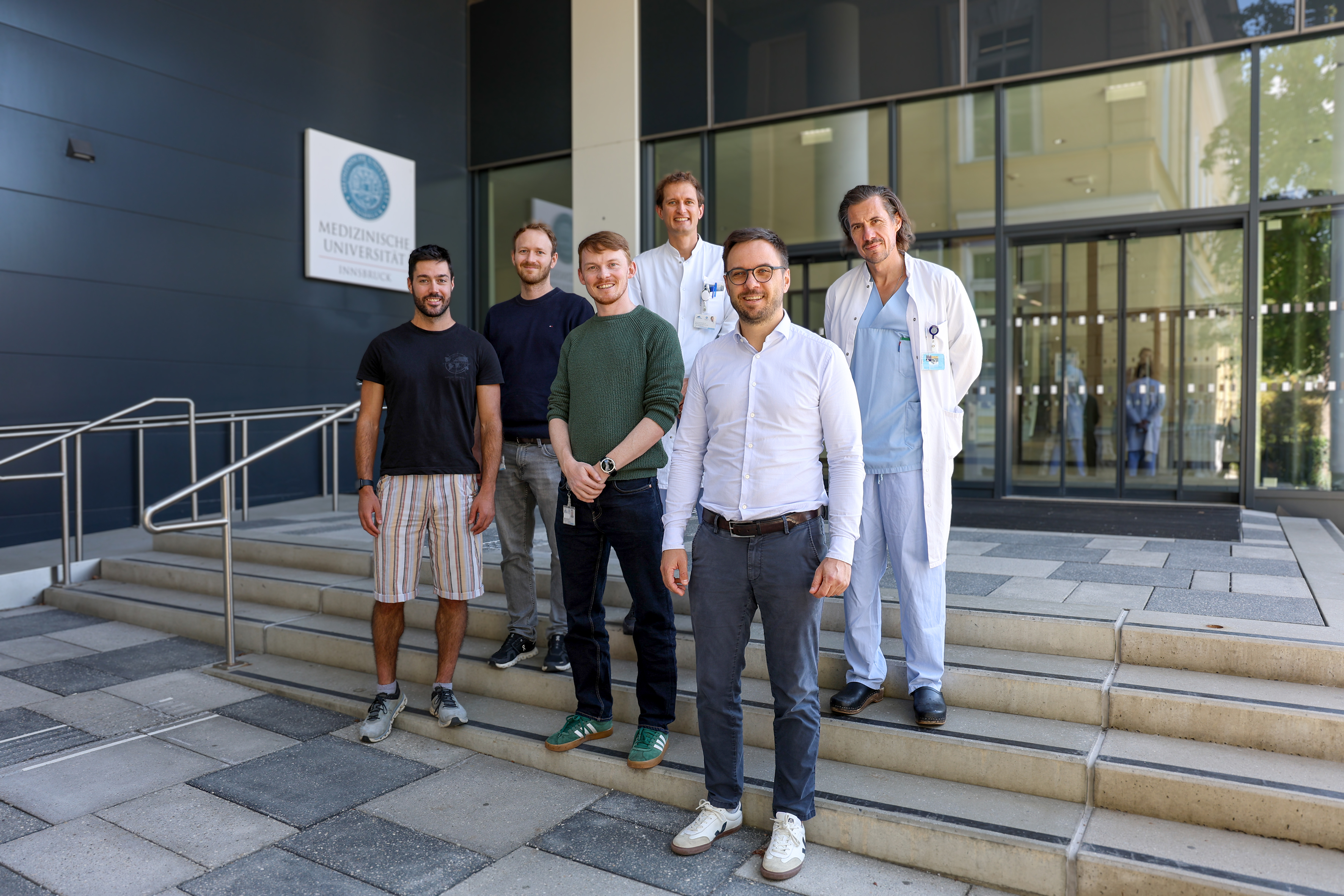
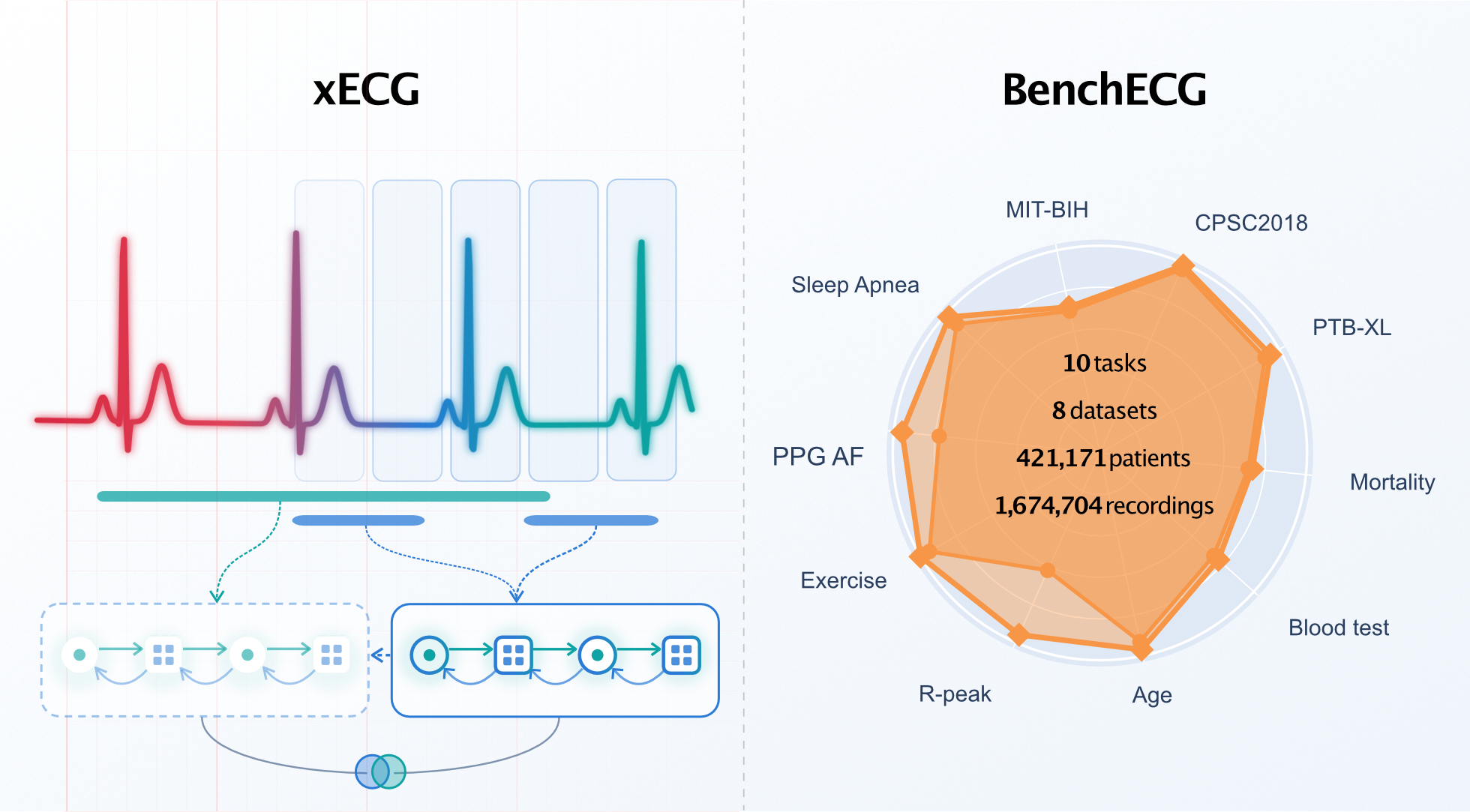
Innsbruck, September 29, 2026: Conventional AI models in medicine are usually trained for a single, narrowly defined task, such as detecting a specific cardiac arrhythmia. So-called foundation models take a different approach: much like a language model such as ChatGPT develops a comprehensive understanding of text, an ECG foundation model learns to “understand” the heart signal in all its diversity and can then flexibly apply this knowledge to many different medical questions—including those for which only a limited amount of specific training data is available. This is a decisive advantage, especially in medicine.
AI Unlocks New Potential in ECGs
The developments of the “Digital Medicine in Cardiology” research group, led by Clemens Dlaska* at the University Clinic for Internal Medicine III (Cardiology and Angiology), are designed precisely for this purpose. “Digital patient information plays a crucial role in the prevention, early detection, diagnosis, and treatment of diseases, particularly in cardiovascular medicine. Physicians rely on a wide variety of data, such as imaging data and electrocardiograms (ECG), to inform their decision-making. Our goal is to harness the high potential of this data from clinical practice using state-of-the-art AI methods, for example, for the prediction and early detection of heart attacks, cardiac arrhythmias, or sudden cardiac death,” reports Dlaska. He and his team – the two first authors, Riccardo Lunelli and Angus Nicolson, as well as Samuel Martin Pröll – developed the xECG foundation model, drawing on the clinical expertise of cardiologists Axel Bauer and Sebastian Reinstadler. The Innsbruck model is based on a combination of the xLSTM architecture— a recently proposed model by a team led by Austrian AI pioneer Sepp Hochreiter at JKU Linz—with a training method from computer vision, which was adapted and applied for the first time to time-series data such as ECGs. “Our xECG model can also efficiently process very long signals, such as nighttime recordings for sleep apnea diagnosis, an area where many other models reach their limits. The computational cost of our system scales linearly with the signal length, which is what makes it so efficient, especially with very long ECG signals. By handling a broad spectrum of conceptually diverse tasks—such as classification, regression, and survival prediction—it currently outperforms other models,” says Clemens Dlaska, explaining the technical advantages of the Innsbruck Foundation Model, which was trained using approximately eight million ECGs from about 1.7 million patients.
A New Benchmark, New Quality
The team also provides evidence of xECG’s leading role in this field. “Our goal wasn’t just to create a single good model. Above all, we wanted to bring clarity and a systematic approach to this field of research, and with BenchECG, we’ve also created a reliable and freely accessible evaluation framework that the entire research community can now build upon,” says Clemens Dlaska. Several research groups worldwide have already developed models in recent years and referred to them as “ECG foundation models.” However, until now, there has been no standardised, verifiable definition of their performance capabilities.
With BenchECG, the Innsbruck team has now defined three key requirements: According to these, an efficient and comprehensive foundation model must, first, be able to handle a broad spectrum of conceptually diverse tasks—ranging from classification and the detection of subtle signal features to the prediction of survival probabilities. Second, it must be able to handle different types of ECG recordings, ranging from the standard clinical 10-second 12-lead ECG to long-term ECGs and smartwatch data. Third, it must function reliably even across very diverse patient groups—from healthy individuals to high-risk patients. “Using publicly available, highly diverse ECG datasets (approximately 1.7 million ECGs from around 400,000 patients), we systematically measured how well the model’s representations transfer across tasks under controlled benchmark conditions. Most of the ECG foundation models we evaluated only partially passed this test; while they performed very well in one area—such as classification—they showed significant weaknesses in other task domains,” Dlaska comments on the results.
The current study is part of a larger research programme at the Department of Cardiology in Innsbruck. “We can cover the entire spectrum from fundamental AI development through concrete applications to clinical trials. The first clinical applications of the model are already in preparation,” say Clemens Dlaska and Clinic Director Axel Bauer, describing the added value of their research.
*) The “Digital Medicine in Cardiology” research group at the Medical University of Innsbruck, led by Clemens Dlaska, works at the intersection of digital technologies and medicine. A key advantage is its location at the University Clinic for Internal Medicine III, Cardiology, and Angiology, which facilitates direct collaboration between medical and technological experts.
Further links:
BenchECG and xECG: a benchmark and baseline for ECG foundation models. Riccardo Lunelli et al., npj Digit. Med. (2026)
Experte Clemens Dlaska
Public Relations und Medien
Media Contact:
Medical University of Innsbruck
Public Relations and Media
Doris Heidegger
Innrain 52, 6020 Innsbruck, Austria
Phone: +43 512 9003 70083
public-relations@i-med.ac.at